
FRIGGMAX SM-100 PRO
One device for data acquisition, supervision, reliable local control, redundant connectivity and a LoRaWAN gateway. Designed for legacy machines and telemetry, without depending on the cloud.
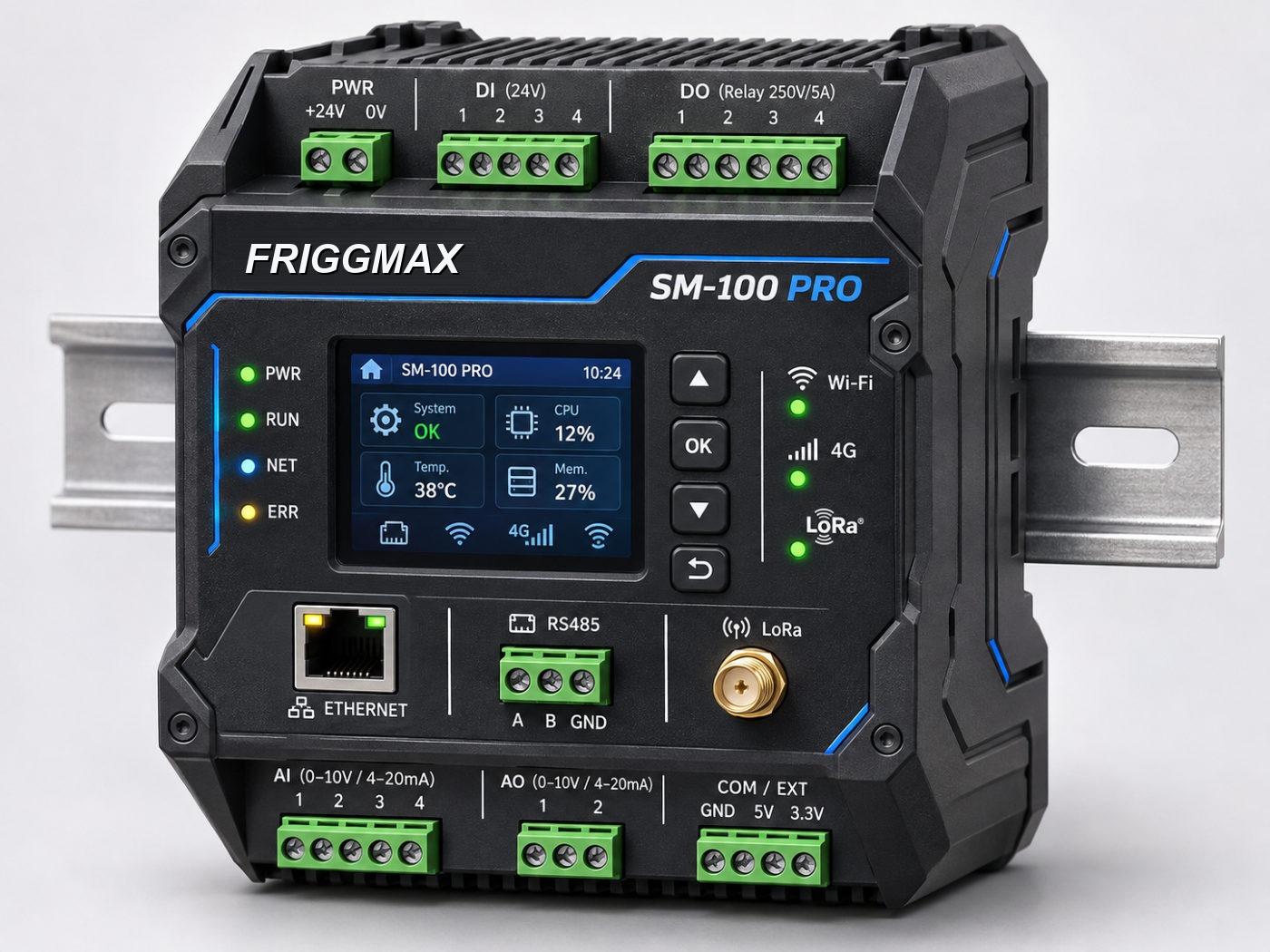
Target specifications (v0.2, not validated)
- Mounting
- DIN enclosure of about 160 × 115 × 95 mm, fanless
- Power
- 24 VDC nominal; target 18–30 VDC
- Processing
- Toradex Verdin iMX8M Plus (Linux) + STM32G474 (control)
- Storage
- eMMC boot + 128 GB industrial SSD (nominal capacity)
- I/O
- 8 DI 24 V · 4 DO 24 V / 0.5 A · 2 AI 0–10 V · 2 AI 4–20 mA · 2 RTD
- Protocols
- Modbus TCP/RTU, MQTT, CAN-FD; OPC UA, KNX and BACnet via software or expansion
- Environment
- IP20 for panels; target −10 to +55 °C, to be validated thermally
Architecture
Select a block to see its role.
Linux (Verdin iMX8M Plus)
Isolated processes, protected root filesystem, signed updates with rollback, MQTT, rules and REST interface.
Energy and internal UPS
The internal battery powers the processor, the MCU and priority communications first. Field outputs are not powered from the reserve by default. The 30–90 s runtime is a target, not a guarantee.
Ideal usable energy
0,250 Wh
Formula: E [Wh] = P [W] × t [h]. Real values are lower due to efficiency, ageing, temperature and cut-off reserves.
Communications
Ethernet
1 × 100/1000Base-T mandatory; VLAN and OT segmentation
Wi-Fi + BLE
2.4/5 GHz with external antenna; BLE for provisioning
4G LTE
Cat 4, eSIM or nanoSIM, with Ethernet fallback
LoRaWAN
SX1302 + RF front-end for an EU868 gateway
RS485
Isolated Modbus RTU, optional termination
CAN-FD
Bus for expansions and nearby sensors
USB-C
Service and diagnostics, controlled use
Reliability principles
01
Linux is never the only output-control mechanism: the STM32 runs the local logic and the fault policy.
02
An external watchdog supervises the MCU; the power supervisor disables outputs on brownout.
03
Storage with batched writes and protection against unexpected power loss, with wear monitoring.
04
Signed updates and automatic system rollback.
Software and platform
STM32: reads DI, AI and RTD, drives DO, runs the watchdog, brownout management and heartbeat.
Linux (Torizon): isolated processes, protected system, rollback and signed updates.
FRIGGMAX core: MQTT, declarative rules, alarms, local history and REST interface.
Optional: accounts, provisioning, multi-site dashboards and cloud reports.
Planned tests and status
- 01
Current status: engineering concept. No certification test has been performed.
- 02
EVT: I/O isolation, 72 h burn-in, consumption with LTE and SSD, UPS transition and fault recovery.
- 03
DVT: EMC/RF pre-compliance, temperature, shock, antenna loss and EU868 duty cycle.
- 04
PVT: calibration, serialisation, automated functional test and traceability.
Compliance and use
- Radio Equipment Directive 2014/53/EU is central because of the integrated radios.
- Also assessed: EMC, RoHS, batteries and the Cyber Resilience Act.
- Never connect 230/400 VAC to the board. Mains measurement must use a certified external analyser over RS485/Modbus.
What it is not
- Does not replace safety relays or safety PLCs: no SIL/PL certification and no emergency-stop function.
- LoRaWAN is not a deterministic channel and does not replace wiring for real-time control functions.
- No manufactured board and no certification test until the pre-compliance phase.
Next technical steps
- Freeze the interface matrix and the choice of battery and mechanics.
- Schematic, bill of materials with part numbers, and a power and radio prototype.
- EMC/RF pre-compliance and thermal tests before the full board.
Want to see the SM-100 PRO in detail?
Talk to our team about technical interviews, pilots and development agreements.